

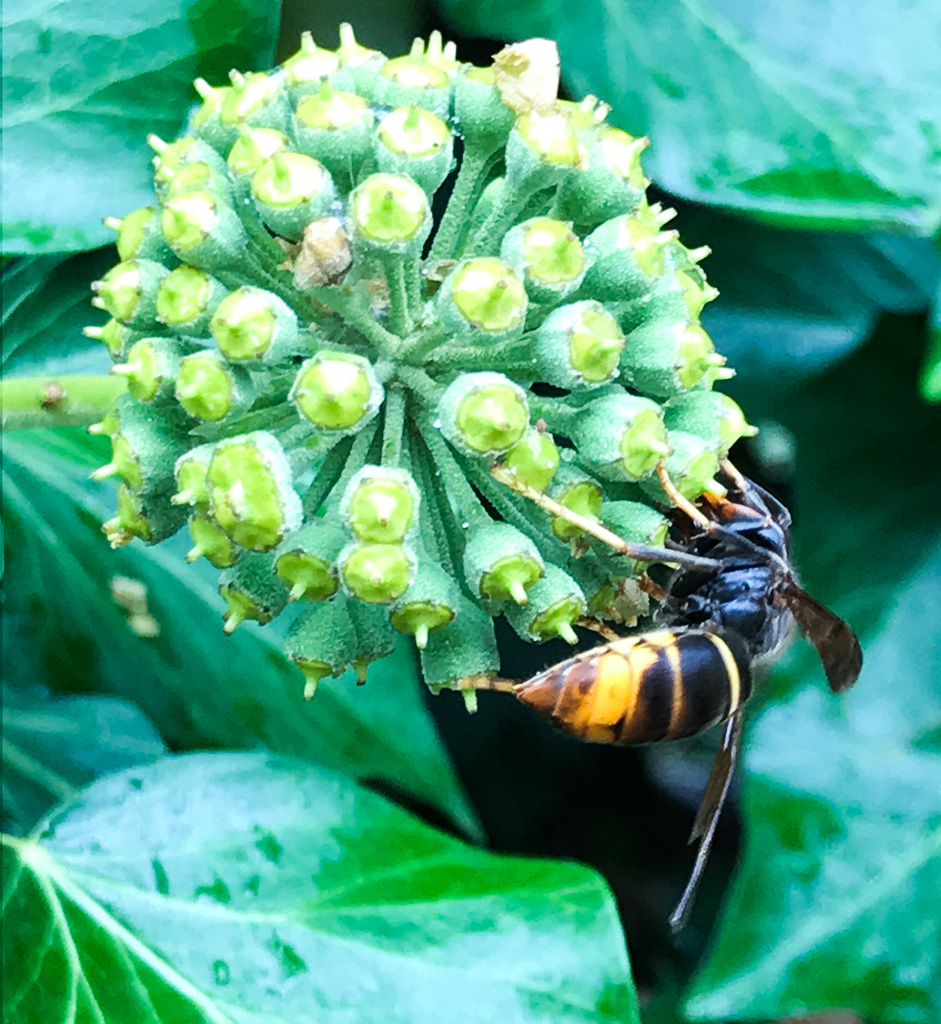
The Asian hornet arrived in France in 2004, in Lot-et-Garonne. Twenty years later, it has been recorded in every department of mainland France. Eradicating the species is no longer considered possible: the challenge now is managing its effects.
Key points
- First observation: 2004, Lot-et-Garonne.
- 13 departments in 2006, 56 in 2012, all of mainland France today.
- The species is also established in several neighbouring European countries.
- Eradication is no longer possible according to the draft national plan.
- The Asian hornet is a generalist predator: the honey bee is its dominant prey out of opportunity, not specialisation.
How did it arrive in France?
The yellow-legged Asian hornet (Vespa velutina nigrithorax) is native to mainland Asia — northern India, China, and the mountainous areas of South-East Asia. Its presence in France was first reported in 2004, in Lot-et-Garonne.
The commonly accepted hypothesis is an accidental introduction with a shipment of goods from China — one account links the event to a delivery of pottery in which an overwintering founder queen was trapped. Genetic analyses carried out since show that the European population descends from a very small number of founders, perhaps a single one.
This point calls for caution: the exact scenario of the introduction is a reconstruction after the fact. What is established is the date, the place, and the very narrow genetic origin of the population.
A fast, well-documented spread
Data from the French National Museum of Natural History makes it possible to follow the colonisation:
| Year | Situation |
|---|---|
| 2004 | First observation, Lot-et-Garonne |
| 2006 | Present in 13 departments in the south-west |
| 2012 | Present in 56 departments |
| Today | Recorded in every department of mainland France |
The species has also spread to neighbouring European countries. Modelling work published as early as 2013 anticipated this expansion and linked it to climate conditions; the 2025 Anses report considers that expansion to the whole of Europe is foreseeable by 2100 because conditions favour its establishment.
Eradication is no longer the goal
The draft national control plan is explicit: "complete eradication of the species is currently no longer possible given its dispersal and the technical and financial resources available". Public strategy now favours strategies to manage and limit its effects, adjusted to the hornet density in each department.
What is its real impact?
The Asian hornet is a generalist, opportunistic predator. It eats a wide variety of insects and targets above all prey that is locally abundant and easy to catch. The honey bee becomes its dominant prey not because it prefers it, but because a hive concentrates thousands of individuals in one fixed spot.
A study by the French National Museum of Natural History estimates that a nest eats on average more than 11 kilograms of insects between March and October, about 38% of them honey bees, 30% flies and 20% wasps.
In apiaries, the main damage is not the number of bees taken but the blocking of the colony's activity: under pressure, bees stop going out and no longer build up their winter reserves.
On wild biodiversity, however, knowledge remains incomplete. The draft national plan states that "the first studies show that the overall impact of the hornet on wild insect communities may be limited", while stressing that the question needs further study. Be wary of categorical claims in either direction.
Why does the Asian hornet attack beehives?
How does predation on a hive work?
From mid-summer, adult hornets take up position hovering in front of the hive entrance, a few dozen centimetres from the landing board. They intercept foragers on their way back, laden and therefore less agile.
The prey is carried away and cut up: only the thorax, the richest in protein, is brought back to the nest to feed the larvae. The adult hornets themselves feed mainly on sugars — nectar and ripe fruit.
A single hovering hornet is enough to change the behaviour of the whole bee colony.
And beyond the hives?
The damage is not limited to beekeeping. In orchards and vineyards, adult hornets attack ripe fruit — grapes, apples, pears — causing lower yields and poorer quality harvests. In vineyards, this damage can encourage rot.
There is also an indirect effect: less pollination as bee colonies weaken.
What is the situation in your area?
LeFrelon publishes nest reports and removals by department, intermunicipality and town.
Frequently asked questions
Is the Asian hornet present everywhere in France?
It has been recorded in every department of mainland France. That does not mean the pressure is the same everywhere: it varies greatly between regions and years, which is exactly what the draft national plan proposes to measure by classifying departments into four density levels.
Since when has it been regulated?
Since 2016 it has been on the list of invasive alien species of Union concern. In France, it has been classified as a category 2 health hazard for the honey bee since an order of 26 December 2012. See the regulations
Have other exotic hornets arrived?
Yes, the oriental hornet, detected in Marseille in 2021 and confined to the south-east. Giant hornets, however, including the southern giant hornet (Vespa soror) seen in Spain, have never been observed in France.
Sources
Information checked on 14/08/2026.