

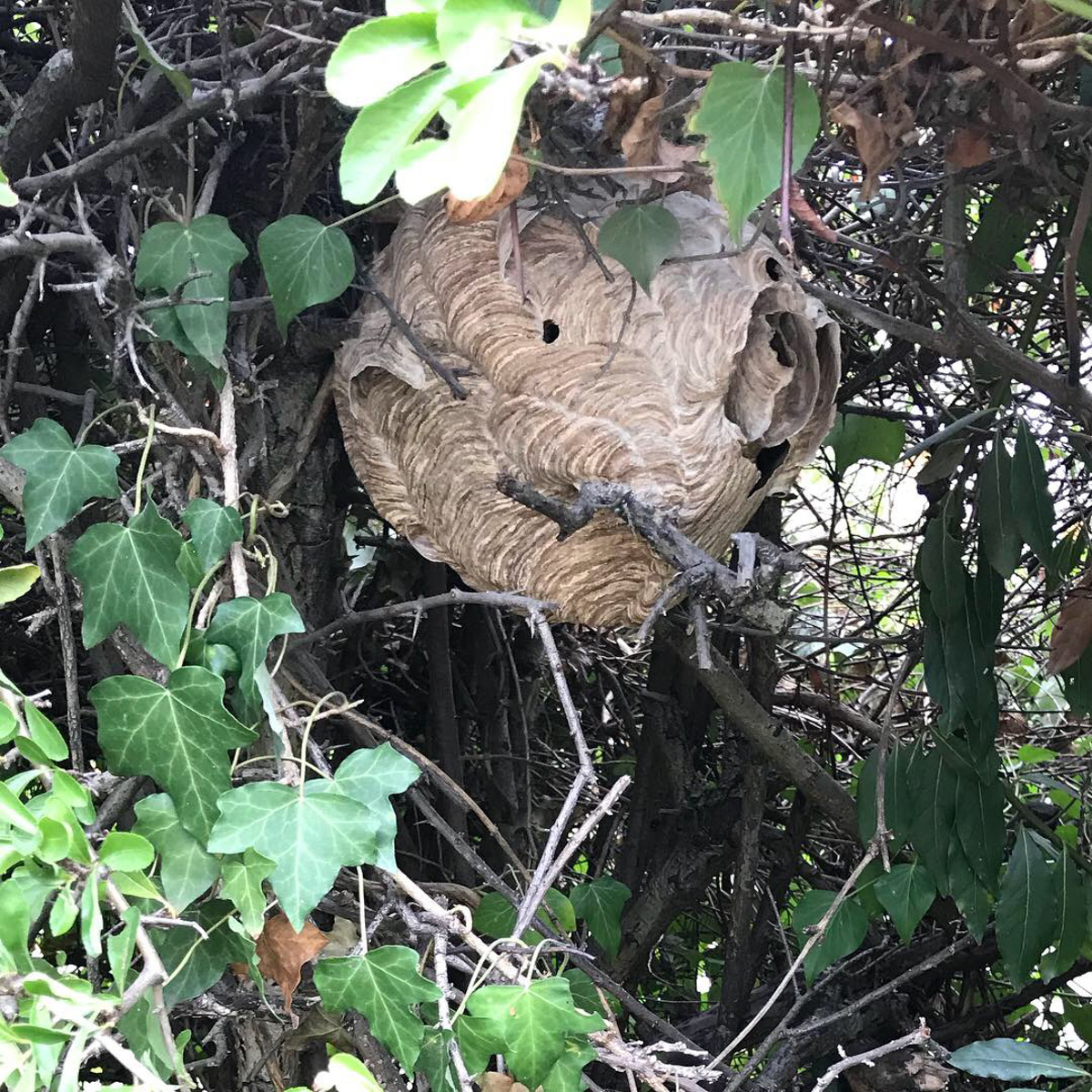
Do not go near it, and above all do not try to destroy it yourself. A disturbed nest triggers a collective attack, and that is when serious accidents happen. Step back at least 5 metres, keep children and pets away, then take the time to check what it is before calling anyone.
Key points
- Stay more than 5 metres away. A single hornet is not very aggressive; a disturbed nest is.
- Never destroy a nest yourself, whether with water, fire or shop-bought insecticide.
- Check the species: many reported nests are actually wasp or European hornet nests.
- You have no legal obligation to have the nest removed if it is on your property. It is a safety decision, not a compulsory step.
- The owner pays for the removal in most cases, unless there is a local support scheme.
- In winter, do nothing: the nest is empty and will not be reoccupied.
Step 1: get to safety
An Asian hornet you come across in the garden or on a flower poses no particular risk. It is not looking for contact and rarely stings of its own accord.
The danger comes from the nest. When someone approaches, the workers sense a threat and come out in numbers to defend the colony. This is how multiple stings happen, which can lead to serious envenomation requiring urgent medical care.
- Keep at least 5 metres between you and the nest
- Do not mow, trim, or use a leaf blower or pressure washer nearby: vibrations are enough to trigger a reaction
- Keep children, people with allergies and pets away
- If the nest is near an entrance, a gate or a play area, close off the way through for now
Call 15 immediately
In the event of multiple stings, a sting in the mouth or throat, a swollen face, difficulty breathing, feeling faint or vomiting. These signs cannot wait.
15 (SAMU, French emergency medical service) · 112 (European emergency number) · 114 (for deaf or hard-of-hearing people)
Step 2: check that it really is an Asian hornet
Many of the nests reported every year are not Asian hornet nests. Common wasps, European hornets and Asian hornets are easily confused from a distance, and only the Asian hornet justifies an intervention as part of the fight against invasive alien species.
Three clues you can see from a distance:
- The nest: an Asian hornet nest is spherical or pear-shaped, with an opening on the side. A European hornet nest is rather open at the bottom.
- The location: the Asian hornet often builds high up in a tree, at the top. The European hornet prefers dark cavities — hollow trunk, attic, roller shutter box.
- The insect: the Asian hornet is darker, with yellow-tipped legs that are very visible in flight.
If you find a small nest the size of a tennis ball in spring, under a garden shed or a roof overhang, it is probably a primary nest, founded by a single queen. This is the easiest stage to deal with.
How to recognise an Asian hornet
Step 3: report the nest
Reporting serves two purposes: improving knowledge of how the species is spreading in your area, and putting you in touch with the control schemes that exist near you.
Since the law of 14 March 2025, article L. 411-9-1 of the Environment Code provides that a nest may be reported through the mayor of your town, or a member of the town council appointed by the mayor. This is an option open to you, not an obligation.
You can also use a reporting platform, which is often quicker.
A common misunderstanding
Reporting a nest does not automatically trigger its removal. The report records the information; the decision to intervene depends on the scheme in place in your department and on how dangerous the nest is.
Where and how to report an Asian hornet nest
Step 4: call in a professional if needed
Removal is never a do-it-yourself job. Amateur attempts — water jet, plastic bag, petrol, insecticide spray — are the main cause of serious accidents involving this species. They almost always fail, scatter the colony and put the neighbourhood at risk.
An equipped professional (full suit, eye protection, telescopic pole) works from a distance, usually at the end of the day or at night when the colony is gathered.
The cost varies greatly depending on height, access and the type of nest. The usual range is about €70 to €250, with no official price for these amounts.
Do you have to have the nest removed?
No. No text requires a private individual to have a nest on their property removed.
The Asian hornet is nonetheless closely regulated: listed as an invasive alien species of Union concern, it is also classified as a category 2 health hazard for the honeybee by the order of 26 December 2012. This classification allows the authorities to organise collective action — it does not create an individual obligation to destroy nests.
However, if the nest is a danger to public safety — near a school, a place open to the public, a busy path — the mayor can step in under their general police powers.
What do the regulations say about the Asian hornet?
Special cases
The nest is at my neighbour's
You cannot call in a professional on property that is not yours. Let your neighbour know, and if talking does not work and the danger is real, contact the town hall.
The nest is on public land
A town-owned tree, street lighting, a bus shelter: it is up to the town to decide on the intervention. Report it to the town hall.
I am a tenant
Removal is usually the landlord's responsibility, as part of the duty to provide decent housing. Let them know in writing.
The nest is very high in a tree, far from everything
A nest far from any human activity poses no direct risk. Report it, but removal is not necessarily required: in departments where the hornet is already widespread, the draft national plan recommends concentrating removals on nests that are dangerous to the public or close to apiaries.
It is autumn or winter
From December, the colony is dead and the nest empty. It will never be reoccupied. Having it removed has no health benefit; the weather will take care of it. The future queens have already left the nest to overwinter elsewhere.
Will the fire brigade come?
In most departments, no: the fire and rescue services no longer systematically deal with hymenoptera nests. They can still step in when there is an immediate risk to people.
Frequently asked questions
Can I destroy a primary nest myself in spring?
It is not advisable. A primary nest is small and lightly defended, but there is no guarantee it still is when you act, and a mistaken identification exposes you to an already developed colony.
Is a shop-bought insecticide enough?
No. Aerosols designed for wasps do not reach the heart of an Asian hornet nest. They irritate the colony without neutralising it, and spread a product into the environment.
Who pays for the removal?
The owner, in most cases. Some towns, intermunicipalities or departments contribute to the cost, but these schemes vary from one area to another and are never automatic. Ask your town hall.
Is there a national number to call?
No, there is no single number. How it is organised depends on your department.
Report the nest in a few minutes
Your report feeds the monitoring of the Asian hornet in your town and points you to local schemes.
Report a nest See the situation in my town
Sources
Information checked on 14/08/2026.