


An Asian hornet colony lives for a single year. It starts at the end of winter with a lone foundress, peaks in October and November, then dies out completely with the cold. Only the young fertilised females survive, hidden elsewhere, to start again the following spring.
Key points
- The cycle is yearly: the whole colony dies when winter comes.
- An empty nest is never recolonised. It can remain for months, but it is harmless for good.
- Peak population in October and November, just before the colony collapses.
- Two nests a year: a small, sheltered primary nest in spring, then a secondary nest in summer, often high up.
- Foundresses overwinter alone in a stump, leaf litter, a woodpile.
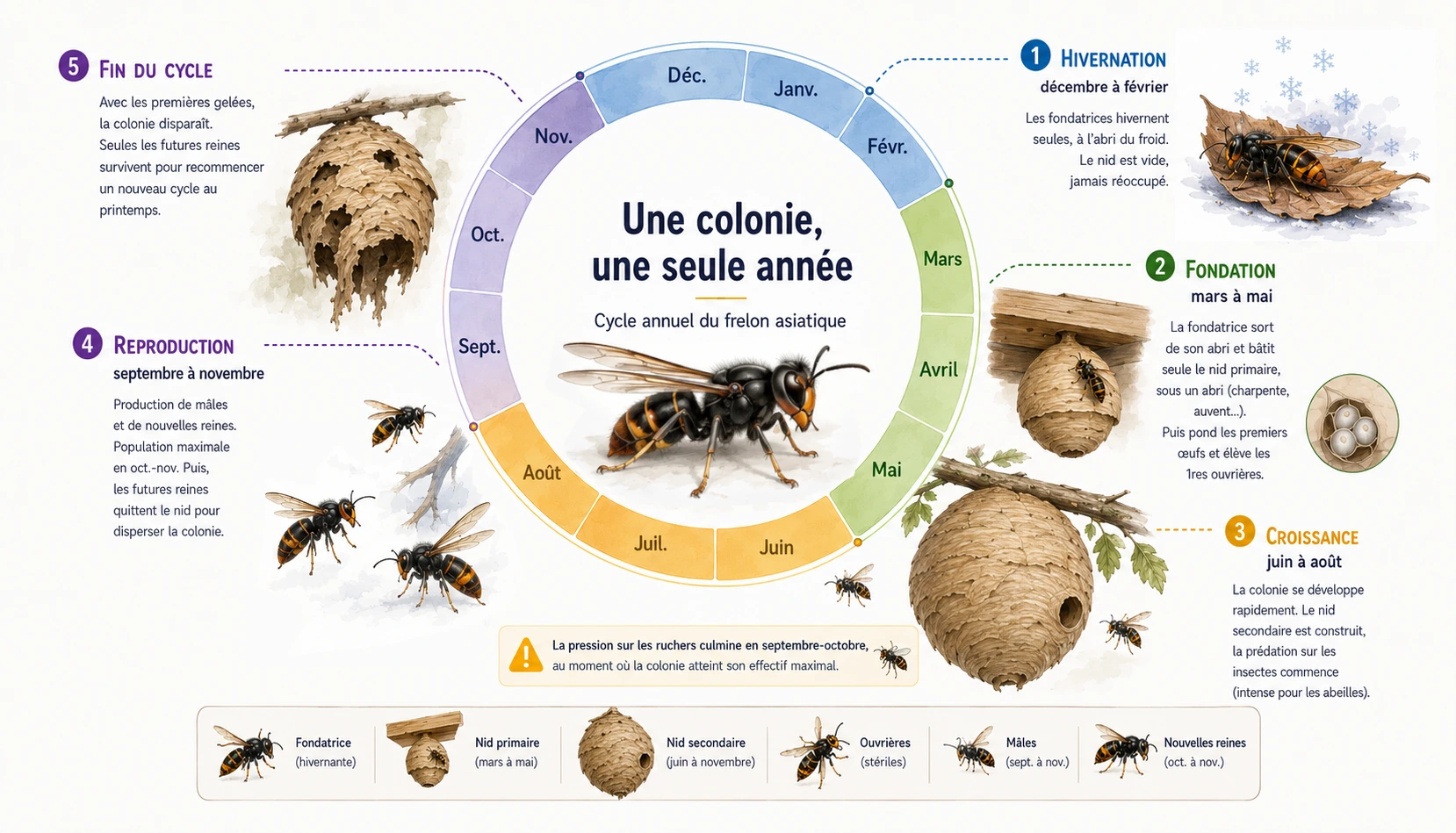
The life of a colony, month by month
-
Hibernation
December to late January
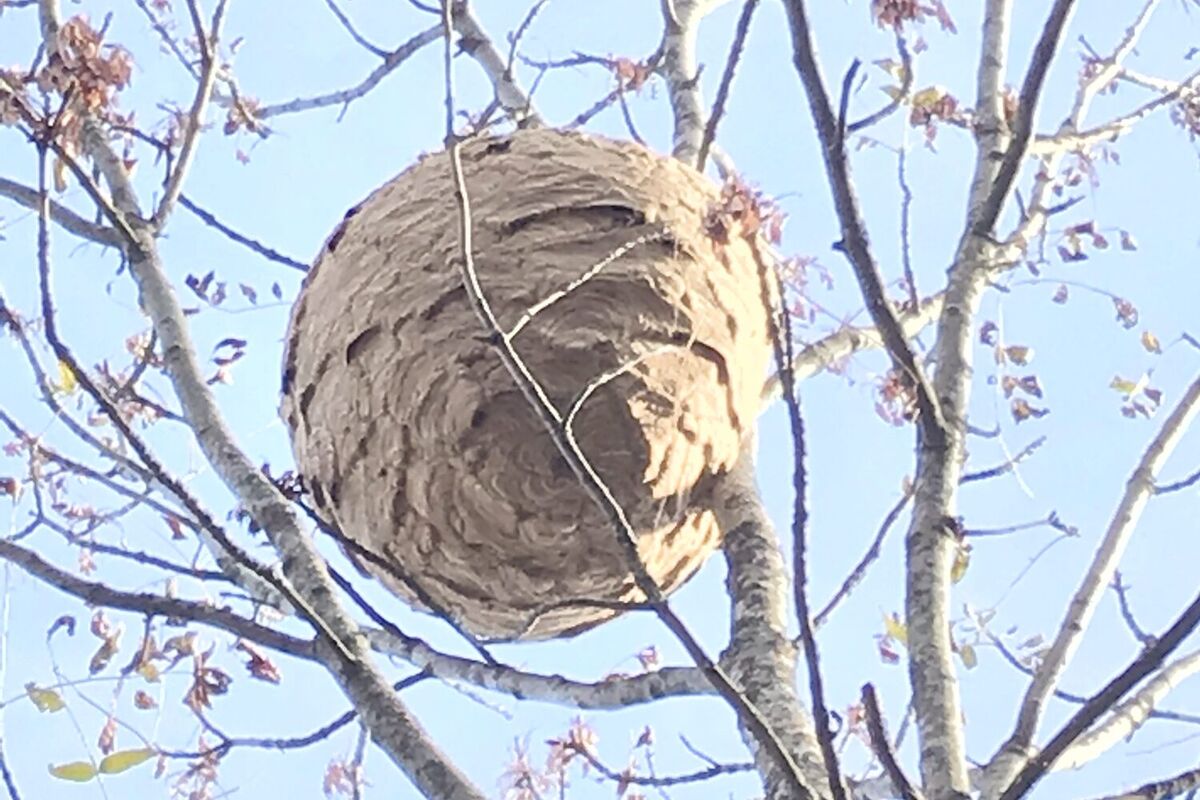
Nests are clearly visible, often high in trees, but they are inactive and abandoned for good. The future foundress queens overwinter on their own in an old trunk, leaf litter, a woodpile or a crevice.
-
End of hibernation and foundation
February to April
The foundresses come out of hibernation and look for a sheltered spot to build the primary nest, or embryo nest. At this stage the foundress is alone: she builds, lays eggs and feeds her first larvae without any help.
Typical locations are protected from the weather: garden shed, roof overhang, barn, window frame, empty nucleus hive.

-
The first workers emerge
Late April, during May
The first workers emerge and take over: caring for the larvae, enlarging the nest, bringing back food. The foundress stops going out and devotes herself to laying.
These first generations are clearly smaller — about 1.5 cm, against 3 cm for later ones. This is the only time of year when size can tell a foundress from a worker.

-
Moving out and the start of predation
June to September
The population grows and the primary nest becomes too cramped. The workers build a secondary nest, where the queen moves to carry on laying. This is also when predation on apiaries begins.
The secondary nest is most often high up in a tree — 73% of nests are more than 10 metres up — but some are also found in buildings (10%) and hedges (3%).

-
Maximum pressure on apiaries
September to October
The colony is fully developed. The workers need to bring back a lot of protein to feed the larvae, and pressure on apiaries is at its highest.
This is when honeybee colonies stop going out and can no longer build up their winter stores — the main damage caused by the Asian hornet.
-
Reproduction
October
The nest produces males and sexual females. Mating takes place, and the young fertilised females will become the following year's foundresses.
In autumn, the differences between workers and future queens can no longer be seen with the naked eye: they can only be measured with optical equipment.
-
The future foundresses disperse
November
The number of adult hornets peaks in October and November, then falls as the fertilised females leave for their overwintering sites. They scatter and will not come back to the nest.
-
Death of the colony
December
The old queen, the workers and the males die. The whole colony dies when winter comes. The nest breaks down under the weather.

An empty nest is never reused
This is the most useful point to remember, and the one most often ignored: an empty nest is never recolonised. Not by the same species, and not the following year.
It can remain for several months after the colony has gone before falling apart in the rain and wind. Throughout that time, it poses no danger and removing it has no health benefit.
The future queens have already left to overwinter elsewhere, scattered across the countryside. Destroying a nest in winter therefore does nothing to reduce the following year's population.
This is also why so many nests are discovered in autumn and winter: built high in the trees, they remain invisible all summer and suddenly appear when the leaves fall, when the colony is already at the end of its cycle.
I have found a nest: what should I do?
What does the Asian hornet eat?
Adults and larvae do not have the same diet, and this explains how the species behaves.
Adults feed on sugars: nectar, ripe fruit, honeydew. That is why they are seen on fruit at the end of summer, and why trapping baits are sweet.
Larvae need animal protein, which the workers have to hunt. The Asian hornet is a generalist, opportunistic predator: it targets prey that is abundant locally and easy to catch, which explains how much honeybees are taken whenever there is an apiary nearby.
A study by the French National Museum of Natural History estimates that a nest eats on average more than 11 kg of insects between March and October, of which about 38% are honeybees, 30% flies and 20% wasps.
Why does the Asian hornet attack beehives?
Frequently asked questions
Should a nest be destroyed in winter?
No. The colony is dead and the nest will never be reoccupied. Removing it achieves nothing, neither for safety nor for the following year's population.
How many hornets live in a nest?
A developed colony has several thousand individuals at the height of the season, far more than the European hornet or common wasps, whose nests rarely exceed a thousand.
Why are there two nests?
The primary nest is built by the foundress alone, in a sheltered spot, low down. It soon becomes too small: the colony then moves to a secondary nest, bigger and often much higher. The two can coexist for a while.
When should action be taken against a colony?
As early as possible in the season. A nest destroyed in September has already done most of its predation and is close to releasing its future queens. See the nest removal page
Sources
Information checked on 14/08/2026.