

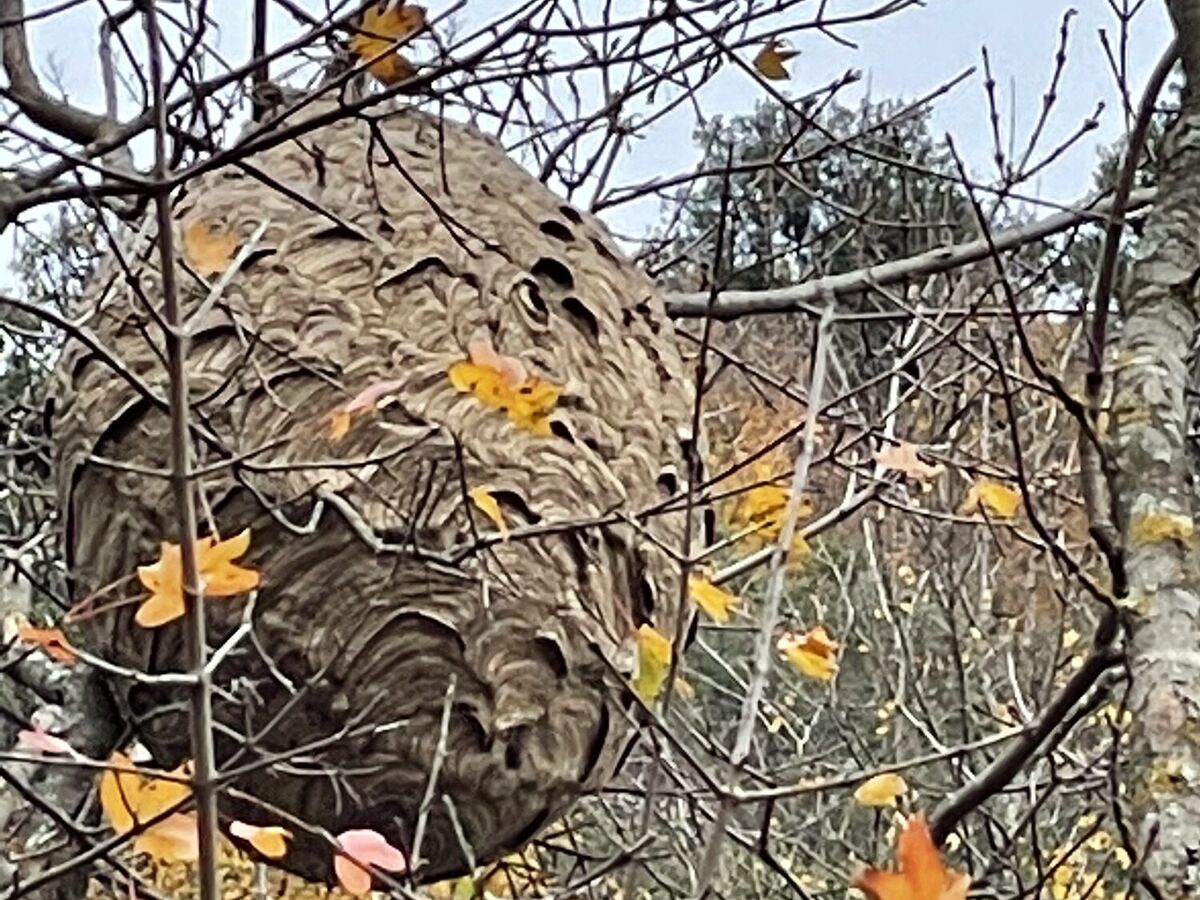
You can report an Asian hornet nest in three ways: online on a reporting platform, to your town hall, or to the body in charge of the fight in your department. None of them is compulsory, and none of them on its own triggers the removal of the nest.
Key points
- Three possible channels: online platform, town hall, department body (FREDON, GDS, beekeepers' group).
- The law opens the way through the mayor, it does not impose it: article L. 411-9-1 says that a report may be made through the mayor.
- Reporting is not the same as removal. They are two separate steps.
- A sharp photo taken from a distance greatly increases the chances of your report being validated.
- There is no single national number. How it is organised depends on your department.
Who to report to in practice
Online, on a reporting platform
This is the quickest way, and the only one that works outside town hall opening hours. A form asks for the location, a photo and a few details.
The French National Museum of Natural History collects Asian hornet sightings as part of the National Inventory of Natural Heritage (INPN), which centralises the species' distribution data at national level.
LeFrelon also provides a reporting form covering the whole country, whose data feeds the area-by-area monitoring published on this site.
To your town hall
Since the law of 14 March 2025, article L. 411-9-1 of the Environment Code provides that "the report may be made through the mayor of the town where the yellow-legged Asian hornet nest is located, or a member of the town council appointed by the mayor".
The wording matters: the law opens this possibility, it does not make it compulsory. Many websites present going through the town hall as a required step. It is not.
The town hall is nonetheless a good contact in two situations: when the nest is on public land, and when your town or intermunicipality contributes to the cost of removals.
To the department control body
Depending on the department, the fight is led by a FREDON, a GDS, a beekeepers' health group or a referent appointed by the prefecture. These organisations often keep the list of contractors and know what local support is available.
The department control plan, adopted by the prefect, sets the procedure that applies where you live.
What do the regulations say about the Asian hornet?
How to make a good report
A usable report comes down to four things.
- A photo, taken from a distance with the zoom. This is what holds up the most reports. Without a picture, the identification cannot be validated — and most reports actually concern wasps or European hornets. Never go closer to get a better shot.
- An accurate location: exact address, or a point on a map. "At the end of the lane" does not allow any intervention.
- The height and the support: tree, roof, hedge, garden shed. This determines the equipment needed.
- Your contact details, so you can be called back if a check is needed.
What happens after your report?
This is the question the web handles worst, and the source of most disappointments.
A report goes through three stages:
- Species validation. A referent looks at the photo. If it is not an Asian hornet, the report stops there.
- Recording. The sighting feeds the monitoring of the species' distribution, which is used in particular to measure predation pressure in each area.
- Guidance. Depending on the department scheme, you are put in touch with a contractor, or told that no support is available.
A report is not an order for an intervention
In most departments, removal remains a separate step that you have to arrange, and usually pay for, yourself.
I have found a nest: what should I do?
Why report, if it does not get the nest removed?
Because data drives public action.
Article L. 411-9-1 provides that the national plan classifies departments according to predation pressure, and that each department plan organises the assessment of how dangerous the reported nests are. This classification relies on the number of nests detected: an area that does not report looks lightly affected, and ends up with fewer resources.
The draft national plan put to public consultation in spring 2026 also plans to bring together the reports currently scattered across several platforms into a single point of contact hosted by the INPN. This plan has not been adopted yet — see below.
Where do the regulations stand?
Three levels not to be confused.
| Text | Status at 14/08/2026 |
|---|---|
| Law no. 2025-237 of 14 March 2025 | In force. Creates article L. 411-9-1 of the Environment Code. |
| Decree no. 2025-1377 of 29 December 2025 | In force since 31 December 2025. Sets out how the plans are adopted. |
| National control plan | Draft. Put to public consultation from 8 to 29 April 2026. Its adoption requires a joint order of the ministers for the environment and for agriculture to be published in the Journal officiel, which had not happened on the date this page was checked. |
Until the national plan is adopted, the department plans that follow from it cannot be adopted — the decree gives them six months after the national plan is adopted. The schemes you come across on the ground today are therefore still, for the most part, earlier local initiatives.
Frequently asked questions
Is reporting compulsory?
No. No text requires a private individual to declare a nest.
Is there a national phone number?
No. There is no single number for the Asian hornet. Neither 15 nor 18 is a reporting channel — keep them for emergencies.
Should I call the fire brigade?
Only if there is an immediate danger to people. In most departments, the fire and rescue services no longer carry out routine removals.
My town offers nothing: what can I do?
Report it online anyway, then contact a professional directly. Check at the same time whether your intermunicipality or your department offers support.
Can I report an empty nest in winter?
It is no use for an intervention, but the information is still valuable for mapping the species. Mention that the nest is inactive.
Report an Asian hornet nest
Location, photo, and you are done. Your report feeds the public monitoring of the species in your area.
Make a report See the situation in my area
Sources
Information checked on 14/08/2026.