

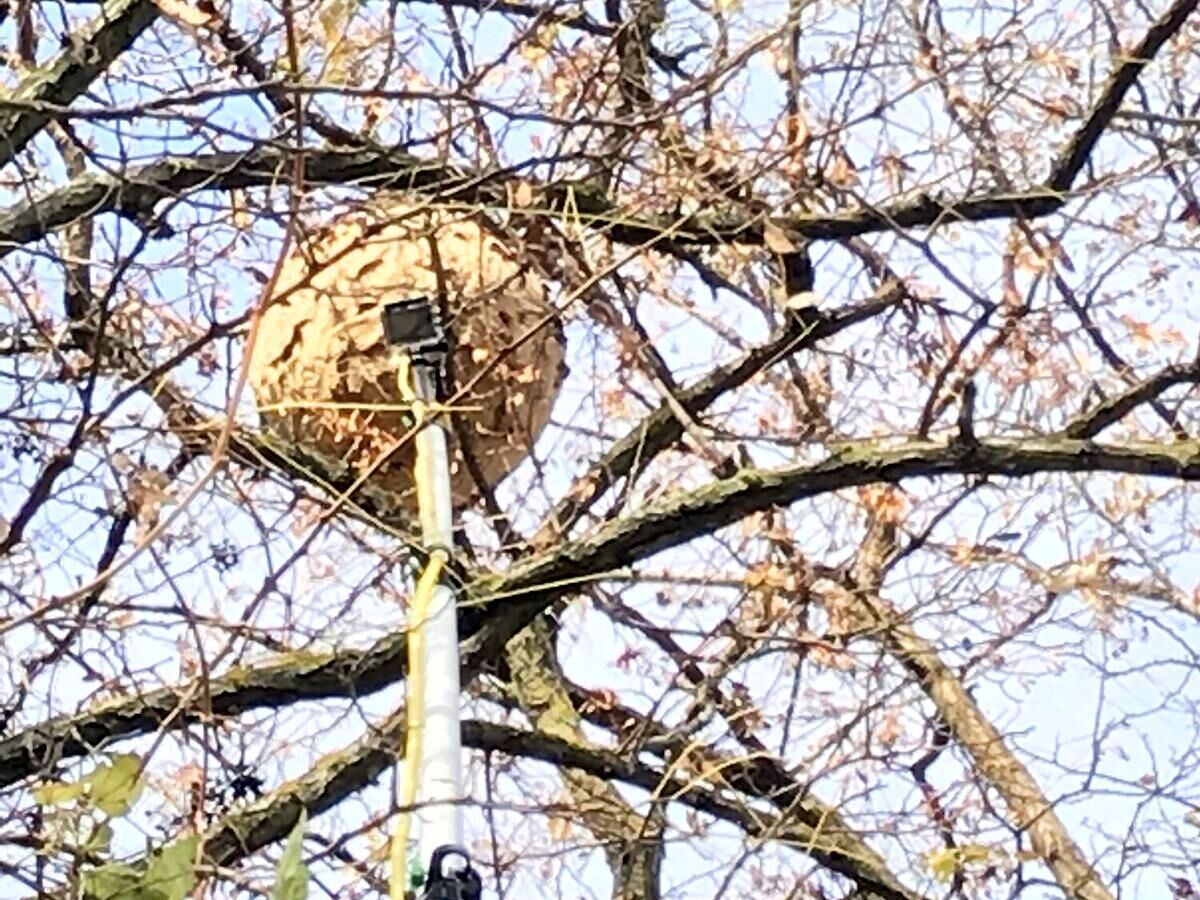
Removing an Asian hornet nest is a job for a professional. It is usually done at night or at the end of the day, from a distance, with a telescopic pole and full protective equipment. Expect to pay between €70 and €250 in most cases, payable by the owner unless there is a local support scheme.
Never try to destroy a nest yourself
Water jet, plastic bag, fire, shop-bought insecticide: these attempts almost always fail, scatter the colony and are the main cause of serious accidents involving this species. A disturbed nest triggers a collective attack.
Key points
- Intervention at night or at the end of the day, when the whole colony is back.
- Usual cost: €70 to €250, with no official price. It mainly depends on height and access.
- The owner pays in most cases — local support exists but varies from area to area.
- No legal obligation to have a nest on your property removed.
- In winter, do nothing: the nest is empty and will never be reoccupied.
How does an intervention work?
A professional steps in at night or at the end of the day. This is not about convenience: it is the only time when all the workers are back in the nest. An intervention in the middle of the day leaves the foragers outside, and they keep circling the spot for several days afterwards.
The operator wears a suit designed for stinging insects, with gloves and eye protection — ordinary beekeeping gear is not enough against a hornet nest. The product is injected from a distance with a telescopic pole, which in most cases reaches high nests without an aerial platform.
The nest must then be taken down wherever possible. A treated nest left in place still contains insecticide and can poison birds or other insects that come to explore it.
Primary nests
Early in the season, a primary nest — the size of a tennis ball, built by the foundress alone — can sometimes be destroyed mechanically, without insecticide. The foundress still has to be inside at the time, which means acting at night.
As soon as the nest houses workers, the operation becomes much trickier and is a job for a professional.
Recognising an Asian hornet nest
How much does removing a nest cost?
Prices vary according to several criteria: the height of the nest, how hard it is to reach, the type of nest (primary or secondary) and whether an aerial platform is needed.
The usual range is about €70 to €250. An accessible, low nest is at the bottom of this range; a nest at the top of a tree that needs special equipment is at the top, or even above.
There is no official price for these interventions: these amounts are observed orders of magnitude, not a price list. Ask for a quote before the intervention.
Can a nest be removed for free?
Sometimes, but never as of right. No national scheme pays for nest removals for private individuals, and there is no right to a free service.
Where support exists, it comes from a local authority that has chosen to provide it:
- a town that pays for interventions in its area, in full or in part
- an intermunicipality that runs the scheme for its member towns
- more rarely a department, often through a body such as the GDS or FREDON
These schemes almost always come with a condition: using an approved contractor, and sometimes having reported the nest first. Calling in a professional yourself and then asking for a refund rarely works.
The useful reflex: call your town hall before ordering an intervention. It is the only way to find out what applies where you live, and the order of the steps often determines whether you are entitled to support.
On the other hand, be wary of "free removal" adverts from companies: the call-out or the quote may be free, the intervention is not.
Who pays?
On private property, the owner pays for the removal. If you are a tenant, it is usually the landlord's responsibility, as part of the duty to provide decent housing: let them know in writing.
On public land — a town-owned tree, street lighting, a bus shelter — the intervention is the town's responsibility.
Local support exists. Some towns, intermunicipalities or departments contribute to the cost, sometimes in full. But these schemes vary greatly from one area to another and are never automatic: check with your town hall before calling in a professional, as support often requires using an approved contractor.
A point to watch about the 2025 law
The law of 14 March 2025 provides for the cost of the fight to be shared between the State, local authorities and businesses, and for removal arrangements to be set out in department plans. These department plans have not been adopted yet: they depend on the adoption of the national plan, which has not happened. The schemes you come across today are therefore still earlier local initiatives.
See the regulations in detail
Should a nest always be removed?
No, and this is counter-intuitive.
A nest far from any human activity, deep in a forest or at the top of an isolated tree, poses no direct risk. The draft national plan goes further: in departments where hornet density is high, it recommends prioritising removal only for nests that are a danger to the public or close to apiaries, and focusing the effort on spring trapping and protecting honeybee colonies.
The logic is arithmetic: where nests number in the thousands, removing a few at random does not change the overall pressure, whereas intervention remains fully worthwhile where it protects people or an apiary.
Conversely, in areas where density is low or zero, systematic removal remains the priority — that is where it can slow the species' spread.
Can the Asian hornet be eradicated?
No. The draft national plan says so explicitly: eradicating the species completely is no longer possible given how widely it has spread and the resources available. The species is present in every department of mainland France.
Public strategy now focuses on managing and limiting its effects: protecting apiaries, reducing risks to people, and documenting the real pressure area by area.
Frequently asked questions
Do the fire brigade step in?
In most departments, the fire and rescue services no longer carry out routine removals. They can still step in when there is an immediate risk to people.
Should a nest be removed in winter?
No. From December, the colony is dead and the nest empty. An empty nest is never recolonised: the weather will take care of it, and the future queens have already left to overwinter elsewhere. See the full life cycle
Do I have to have the nest on my property removed?
No. No text requires a private individual to have a nest on their property removed. It is a safety decision, not a compulsory step.
How do I find a professional?
Contact your town hall, or the GDS or FREDON of your department: they often keep a list of contractors and know what local support is available.
Report the nest before any intervention
Your report feeds the monitoring of the Asian hornet in your town and points you to local schemes.
Report a nest See the situation in my town
Sources
Information checked on 14/08/2026.