

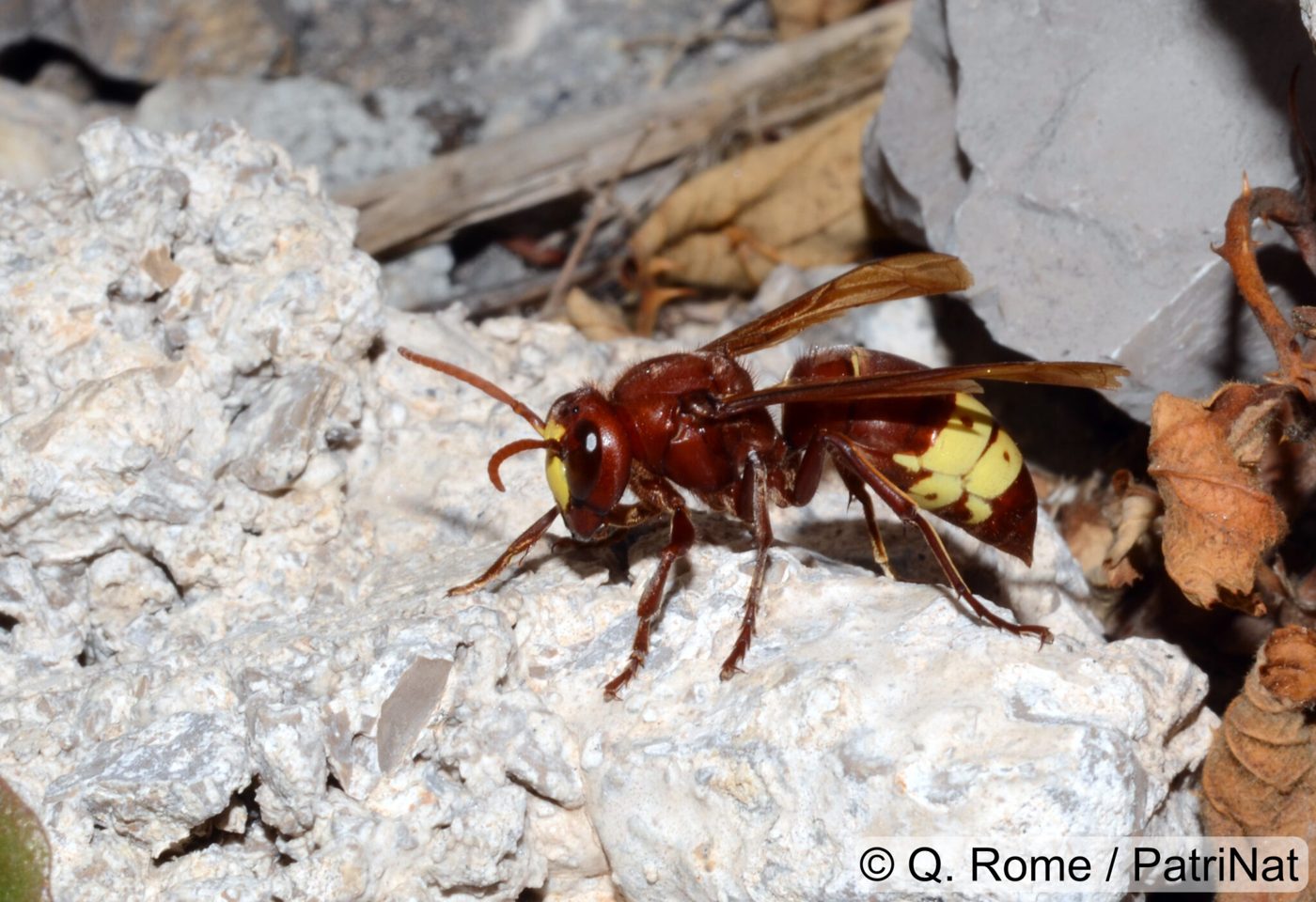
The oriental hornet has been established in France since 2021, but it remains very localised and far less widespread than the yellow-legged Asian hornet. Contrary to what is often written, Anses states that it is not aggressive towards humans and that it is not a threat to honey bees.
Key points
- First observation in France: 22 September 2021 in Marseille.
- Found mainly in the Bouches-du-Rhône, with observations in the Var and the Alpes-Maritimes since 2023.
- Its nests are underground and about three times smaller than those of the Asian hornet.
- According to Anses, it has little interaction with humans and is not aggressive towards them.
- Not to be confused with the yellow-legged Asian hornet, which is far more widespread.
How to recognise it?
The oriental hornet is clearly different from the two hornets usually seen in France. Its colouring is very distinctive: a largely reddish-brown body with a broad bright yellow band on the abdomen and yellow markings on the head.
| Oriental hornet | Yellow-legged Asian hornet | European hornet | |
|---|---|---|---|
| Main colour | Reddish-brown | Very dark brown to black | Yellow and reddish-brown |
| Distinctive feature | Broad yellow abdominal band | Yellow leg tips | Yellow abdomen striped with black |
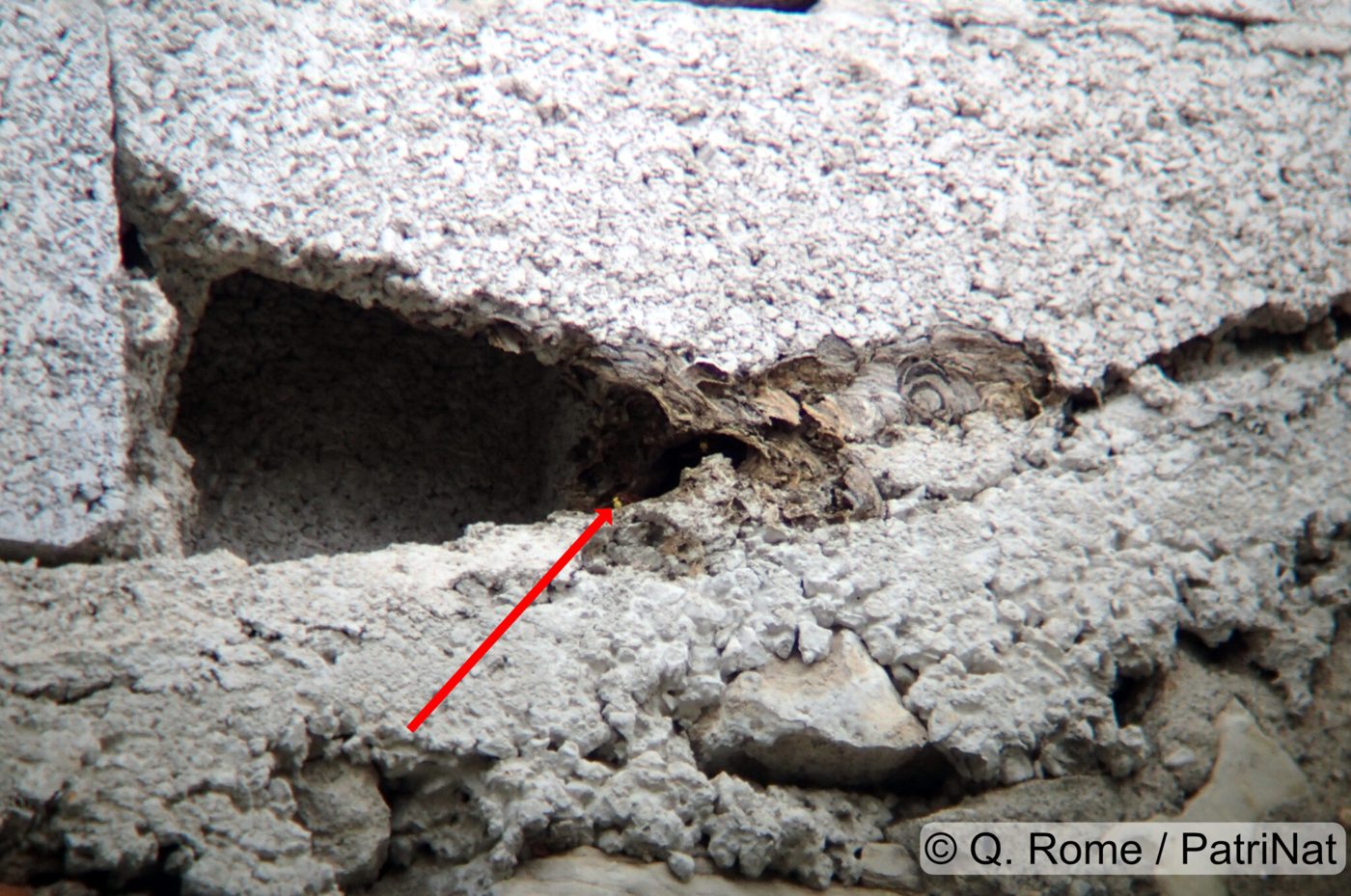
| Nest | Underground | Aerial, often high up | Cavity, hollow trunk, attic |
| Nest size | ~1,000 individuals max | Several thousand | ~1,000 individuals |
How to recognise an Asian hornet?
Since when has it been in France?
The oriental hornet was first observed in France on 22 September 2021, in Marseille, in the Cabucelle district, on the wasteland of the former Saint-Louis factory. It was identified by three entomologists from the consultancy Ecotonia, whose discovery was published in the journal Faunitaxys.
A nest was already established in 2021. The species' presence in the Marseille area was confirmed in the following years, with one nest destroyed in 2022 and another in 2023, as well as individuals observed at points far enough apart to indicate other nests.
In 2023, the species was also detected in the Var and the Alpes-Maritimes.
Where does it come from?
How it arrived in France has not been settled.
Accidental introduction by shipping was the first hypothesis, given that it was first detected near the port. The species has indeed been accidentally introduced in southern Spain — in Valencia in 2012, then in Algeciras in 2018 — as well as in Chile.
But its detection in the Var and the Alpes-Maritimes changed that reading. According to Anses, it rather suggests a natural expansion of its range from the Italian peninsula, where the species occurs naturally and is moving north as the climate warms.
Is it dangerous to humans?
No, according to Anses. Its June 2025 report is explicit: the oriental hornet "has little interaction with humans and is not aggressive towards them".
This conclusion directly contradicts many press articles and commercial websites published since 2021, which describe the species as "dangerous to humans". These claims are not based on any French health data.
As with any hymenopteran, a sting is still painful and can trigger an allergic reaction in a sensitised person. And as with any social species, approaching a nest triggers a defensive reaction. The 5-metre rule therefore applies here too — with an added difficulty: since its nests are underground, they are much less visible, and the risk of disturbing them by accident while gardening is higher.
Is the Asian hornet dangerous to humans?
Is it a threat to bees?
This is where sources disagree, and it should be said plainly.
Anses concluded in June 2025 that the oriental hornet "is not a threat to bee health".
The Invasive alien species resource centre, run by the French Biodiversity Agency and IUCN France, described it at the time of the first detection as "a new threat to beekeeping, because of its predation on honey bee colonies".
These two positions are not entirely incompatible: the oriental hornet does take bees, but Anses considers the pressure it exerts to be on a completely different scale from that of the Asian hornet. Given that it is more recent and was reviewed by PatriNat (OFB-MNHN), the Anses assessment is today the reference. The question is nevertheless worth following: French numbers of the species are still too low to draw a definitive conclusion.
What to do if you think you have seen one?
Take a photo from a distance and report the sighting. The French National Museum of Natural History collects oriental hornet reports at [email protected]; give the location, the date, and where the nest is if you have spotted it.
Never try to destroy an underground nest yourself.
Frequently asked questions
Will the oriental hornet replace the Asian hornet?
Nothing supports that claim. The two species occupy different niches — underground nest versus aerial nest — and the oriental hornet remains confined to the south-east.
Is it classified as an invasive alien species?
It is not on the list of invasive alien species of Union concern, unlike the yellow-legged Asian hornet.
Why are its nests underground?
It is the species' usual way of nesting in its original Mediterranean and Middle Eastern range. It uses cavities in the ground, sometimes walls or compost bins.
Are there other exotic hornets in France?
No. The oriental hornet is the only exotic hornet established in France apart from the yellow-legged Asian hornet. Giant hornets are not found there. Southern giant hornet (Vespa soror): should we worry?
Sources
-
Gereys B., Coache A., Filippi G. et al. (2021), Faunitaxys — publication of the first French observation
Information checked on 14/08/2026.