
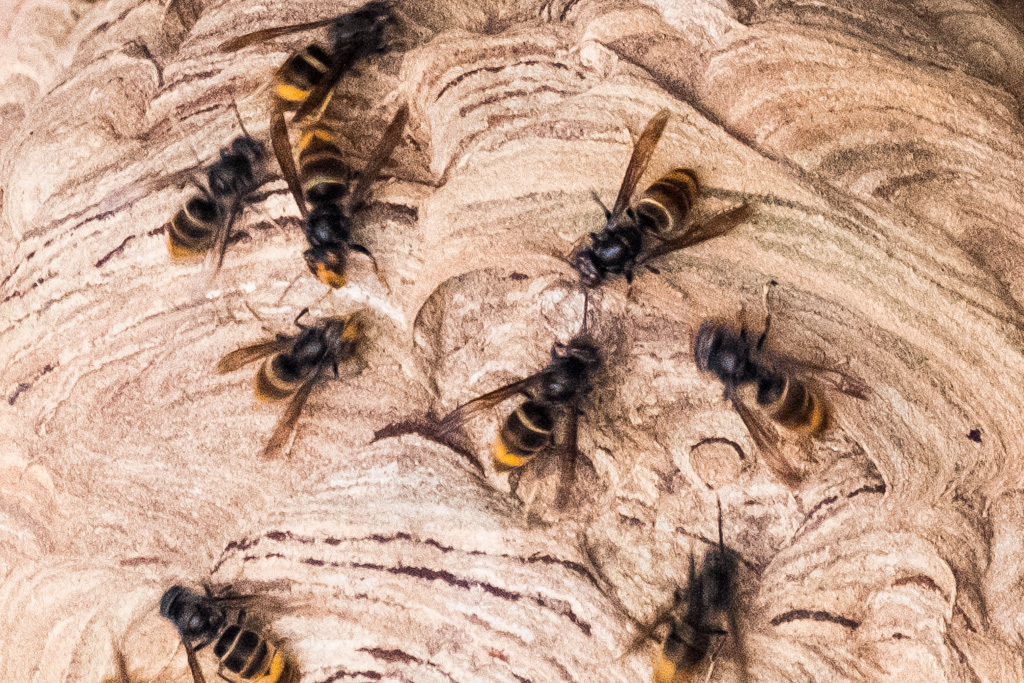
No more than a wasp, as long as you stay away from its nest. A single Asian hornet you come across on a flower or a terrace is not looking for contact and rarely stings. The real risk arises in two situations: when you go near a nest, and when you are allergic to hymenoptera venom — in which case a single sting can be enough.
Key points
- The Asian hornet is no more venomous than the European hornet. Its sting is painful, rarely serious for someone who is not allergic.
- Hornets, all species combined, cause 38% of serious envenomations recorded by poison control centres, while they account for only 25% of stings.
- 89% of serious cases are allergic reactions, and a single sting was enough in nearly half of them.
- The danger comes from the nest: a disturbed nest triggers a collective attack.
- Stay more than 5 metres away from any hornet nest.
What French health data says
In June 2025, Anses (the French agency for food, environmental and occupational health and safety) published a toxicovigilance study covering ten years of data, from 2014 to 2023, cross-referencing calls to poison control centres, emergency department visits, hospital admissions and death certificates. It is now the most solid reference on the subject in France.
Over that period:
- 6,022 calls to poison control centres for hymenoptera stings, including 91 serious cases (1.5%)
- 179,141 emergency department visits, 2% of which led to a hospital admission
- 18,213 hospital admissions, 13% of them in intensive care
- 256 deaths linked to a hymenoptera sting, i.e. 12 to 47 a year
Compared with the French population, these figures describe a real but rare risk. They concern all hymenoptera: bees, wasps and hornets combined.
Is the hornet more dangerous than the wasp or the bee?
On one specific point, yes: relative severity.
Hornets, all species combined, are responsible for 38% of serious envenomations recorded by poison control centres, while they account for only 25% of stings. In other words, a hornet sting is statistically more likely to go wrong than a wasp or bee sting.
There are two reasons for this:
- The hornet does not lose its sting. Unlike the bee, it can sting several times in a row and inject venom each time.
- The amount of venom injected is greater, which makes the toxic reaction more severe for the same number of stings.
However, nothing suggests that Asian hornet venom is different in nature from that of other hornets. Claims about a "neurotoxic and cardiotoxic" venom specific to this species, common online, do not appear in the Anses report.
The real risk factor: allergy
This is the point most articles miss.
Among the serious envenomations recorded by poison control centres, 89% involved an allergic reaction, alone or combined with toxic signs. And in 48% of serious cases, a single sting had been enough — a proportion that rises to 53% for hornets.
Severity therefore depends first not on the number of stings, but on the person who is stung. An allergic reaction is not dose-related: it can occur after a single sting, in someone who has been stung before without any problem.
The report also points to a little-known mechanism: people most often become allergic to hornet venom after a wasp sting, because of cross-allergies between these venoms.
Who is most at risk?
The data shows two distinct profiles.
For the number of stings, 20 to 39-year-olds are the most affected — the age group most active outdoors.
For severity, it is men over 60, whatever the data source. People stung by a hornet are also, on average, clearly older than those stung by another hymenopteran: 50 against 31. A plausible explanation is exposure during gardening or maintenance work, which disturbs nests.
Geographically, hornet stings are more frequent in the west, south-west and south-east of France.
How many people does the Asian hornet kill each year?
Nobody can answer this question, and you should be wary of websites that give a figure.
The 256 deaths recorded between 2014 and 2023 concern all hymenoptera. A hornet — all species combined — is mentioned in 27% of these death certificates. But in calls to poison control centres, the hornet species could not be identified in 48% of cases: only 28% were formally yellow-legged hornets, and 24% European hornets.
There is therefore no data that makes it possible to isolate the deaths attributable to the Asian hornet. What is established, however, is that the share of hornets in death certificates increased over the period, from 15% in 2014 to 43% in 2023.
How far from a nest should you stay?
At least 5 metres, the safety distance recommended by Anses.
Beyond distance, what matters is disturbance. The risky situations are almost always the same:
- Trimming a hedge, pruning or mowing near a nest nobody has spotted
- Leaf blower, pressure washer, chainsaw: noise and vibrations are perceived as an attack
- Work on a roof or in a garden shed
Before any gardening work, check that there is no nest in a bush, a hedge or under the eaves. It is Anses's number one prevention recommendation, and the most effective.
When is the hornet most active?
Medical visits for hymenoptera stings peak every year in July or August. This seasonality follows the colony's cycle: nests reach their largest population at the end of summer, when defensive activity is at its highest.
This is also when secondary nests, often built high up, become visible from the ground.
Frequently asked questions
Does the Asian hornet attack for no reason?
No. Away from the nest, it tends to avoid contact. Collective attacks are defensive reactions.
Is its sting more painful than a wasp's?
It is generally described as more painful, because of the amount of venom injected. That does not mean it is more dangerous for someone who is not allergic.
Can an Asian hornet sting through clothing?
Yes, through thin fabric. The protective suits used by professionals are designed for this.
Should a nest be destroyed as a precaution?
Not systematically. A nest far from any human activity poses no direct danger. I have found a nest: what should I do?
Have you spotted a nest?
Report it to help monitor the Asian hornet in your town.
Report a nest What to do if you are stung
Sources
Information checked on 14/08/2026. This content is for information only and does not replace medical advice. If in doubt, call 15 (or 112) or see a doctor.