


Look at three things: the entirely black thorax, a single wide orange segment on a dark abdomen and, above all, the yellow tips of the legs — the most visible criterion, even in flight. Do not rely on size: the Asian hornet is not bigger than the European hornet.
Key points
- Yellow-tipped legs: the decisive criterion, and the only one you can read from a distance.
- Entirely blackish-brown thorax in the Asian hornet, reddish brown in the European hornet.
- A single wide orange segment on an otherwise dark abdomen.
- Size: 17 to 32 mm depending on the caste. The European hornet is bigger on average.
- Many look-alikes are harmless — including two flies. Count the wings: four on a hornet, two on a fly.
Asian hornet or European hornet?
The yellow-legged Asian hornet (Vespa velutina nigrithorax) is mostly black, with a wide orange band on the abdomen and a thin yellow edge on the first segment. Seen from the front, its head is orange, and its legs are yellow at the tips. It measures between 17 and 32 mm.
The European hornet (Vespa crabro) has a mostly pale yellow abdomen with black bands. Its head is yellow from the front and red on top. Its thorax and legs are black and reddish brown. Workers measure between 18 and 23 mm and queens between 25 and 35 mm.
The oriental hornet (Vespa orientalis) is the same size as the European hornet. It is reddish brown all over: only the front of its head and one band on its abdomen are yellow. In France, it is only found in the south-east.
More about the oriental hornet
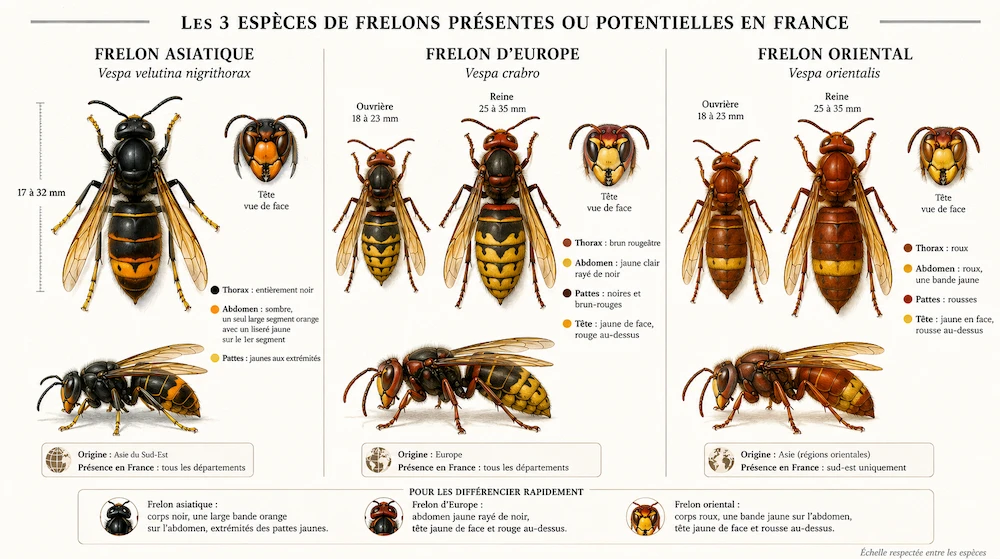
| Asian hornet | European hornet | Oriental hornet | |
|---|---|---|---|
| Thorax | Entirely blackish brown | Reddish brown | Reddish brown |
| Abdomen | Dark, a single wide orange segment | Pale yellow striped with black | Reddish brown, one yellow band |
| Legs | Yellow at the tips | Black and reddish brown | Reddish brown |
| Head (from the front) | Orange | Yellow, red on top | Yellow on the front |
| Size | 17 to 32 mm | 18 to 23 mm (workers), 25 to 35 mm (queens) | Same as the European hornet |
| Presence in France | Every department | Every department | South-east only |
Queen, foundress, worker: how to tell them apart
A foundress is a female that has survived the winter and founds a new colony in spring. At that time of year, she is the only one you will see on her own, building a small nest.
In spring, you can tell them apart by size: the first generations of workers measure about 1.5 cm, against about 3 cm for a foundress and for later generations of workers.
However, in autumn, the differences between workers and young sexual females can no longer be seen with the naked eye: they can only be measured with optical equipment. If someone claims they can recognise a future queen on an autumn photo, be wary.
This matters for trapping: so-called "spring" trapping targets foundresses, precisely because this is the only period when they can be identified and when each capture means one nest that will never exist.
Did you see a black hornet? An orange one? One with a yellow head?
Here is what the most common descriptions correspond to.
| What you saw | It is probably |
|---|---|
| A very dark, almost black hornet with yellow legs | An Asian hornet. The thorax is entirely black and only one segment of the abdomen is orange. |
| A rather pale, fairly big yellow and black hornet | A European hornet. A native, useful species that should not be destroyed without good reason. |
| A yellow or orange head seen from the front | The Asian hornet has an orange face, the European hornet a yellow face and a red top. |
| An orange and black insect hovering in front of flowers | Probably a fly — a hornet hoverfly or a hornet-mimic hoverfly. Two wings instead of four, and it does not sting. |
| A very large black insect with a bluish sheen | A carpenter bee. Impressive, harmless, useful. |
| A shiny, very hairy black insect with four yellow spots | A mammoth wasp. It parasitises beetle larvae. |
| A very large yellow and black insect with a long spike at the back | A giant woodwasp. The "spike" is an ovipositor for laying eggs in wood. Harmless. |
| An insect that is reddish brown almost all over | An oriental hornet — but only in the south-east of France. |
The deciding reflex: count the wings. A hornet, a wasp and a bee have four — two pairs; a fly has only two, a single pair, with big eyes and short antennae.
Look-alikes: insects mistaken for Asian hornets
A large share of reports actually concern other species, often perfectly harmless ones. Here are the most frequent mix-ups.
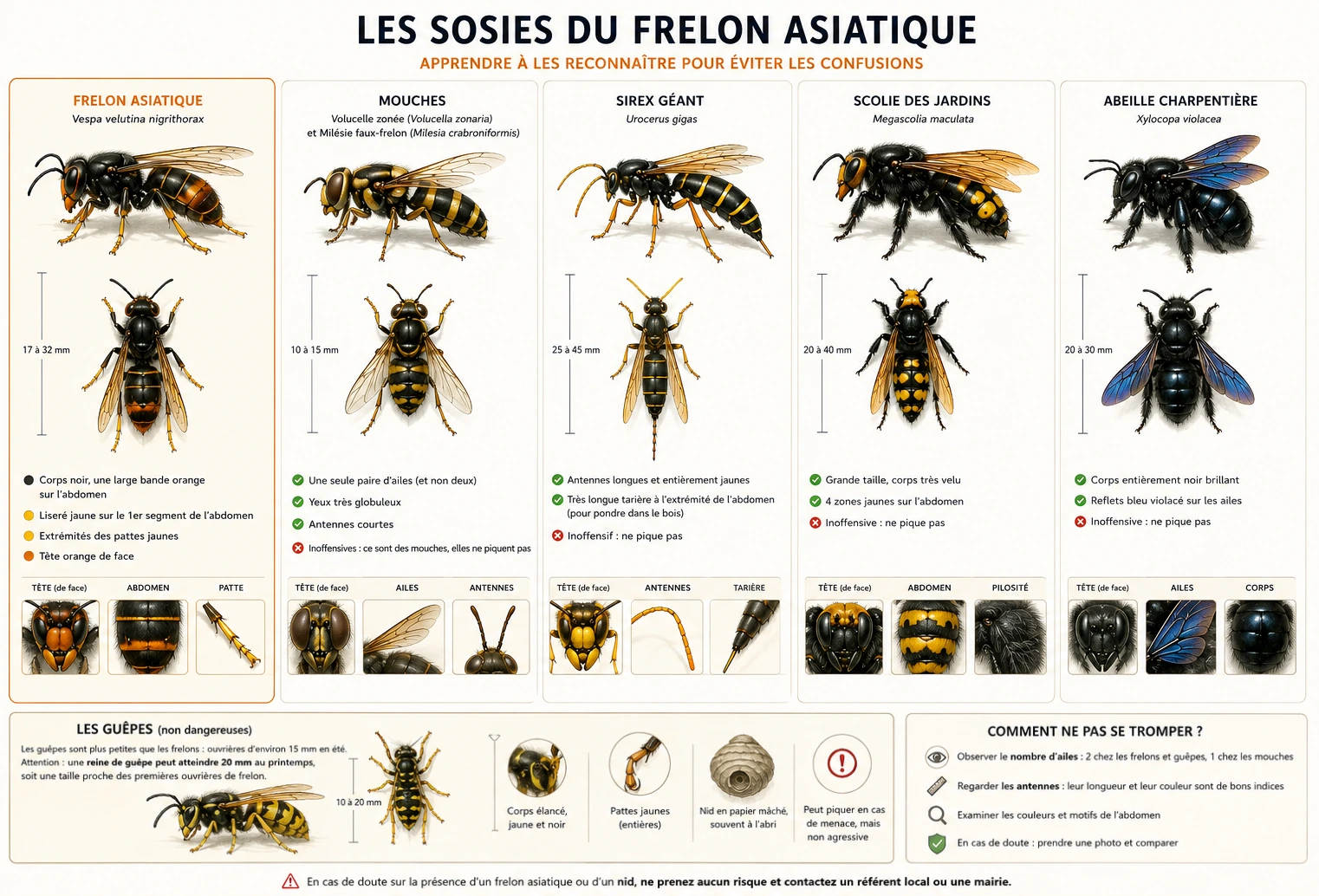
Flies: the hornet hoverfly and the hornet-mimic hoverfly
The hornet hoverfly (Volucella zonaria) and the hornet-mimic hoverfly (Milesia crabroniformis) copy a hornet's colours remarkably well. They are flies: they do not sting.
The test is simple and works on a photo: a fly has only one pair of wings — two wings in all — whereas a hornet has two pairs, four wings. Its eyes are much more bulging and its antennae clearly shorter.
The giant woodwasp
The giant woodwasp (Urocerus gigas) is a hymenopteran whose larva feeds on wood. The female can reach 4.5 cm and its colouring is close to that of the Asian hornet. It can be told apart by its long, entirely yellow antennae, and by its long ovipositor used to lay eggs in wood — often mistaken for a giant sting. This insect is harmless.
The mammoth wasp
The mammoth wasp (Megascolia maculata) is one of the largest European "wasps". It is very hairy, with a shiny black body, a head that is yellow on top, and an abdomen with four yellow, hairless patches. It parasitises the larvae of large beetles.
The carpenter bee
The carpenter bee (Xylocopa violacea) measures between 2 and 3 cm. It is entirely black with bluish-purple reflections — impossible to confuse once you know, but its size and noisy flight are worrying. It nests in dead wood and feeds its larvae with pollen.
Wasps
Wasps are smaller than hornets: workers measure about 15 mm at the end of summer. Be careful though: a wasp queen can be slightly over 20 mm, so in spring a wasp can be bigger than the first hornet workers. Size alone is not conclusive.
The European hornet should not be destroyed without good reason
It is a native, useful species, and far more discreet than its reputation. Every year, mistaken identification leads to the destruction of nests of European hornets and wasps that pose no particular danger. If in doubt, take a photo from a distance and have it checked before any intervention.
Recognising an Asian hornet nest
The Asian hornet nest
The primary nest, or embryo nest, is built by the foundress queen when she comes out of hibernation in spring. It is usually in a sheltered spot — an empty hive, a garden shed, a hole in a wall, the edge of a roof, a bramble patch. It is small and low down.
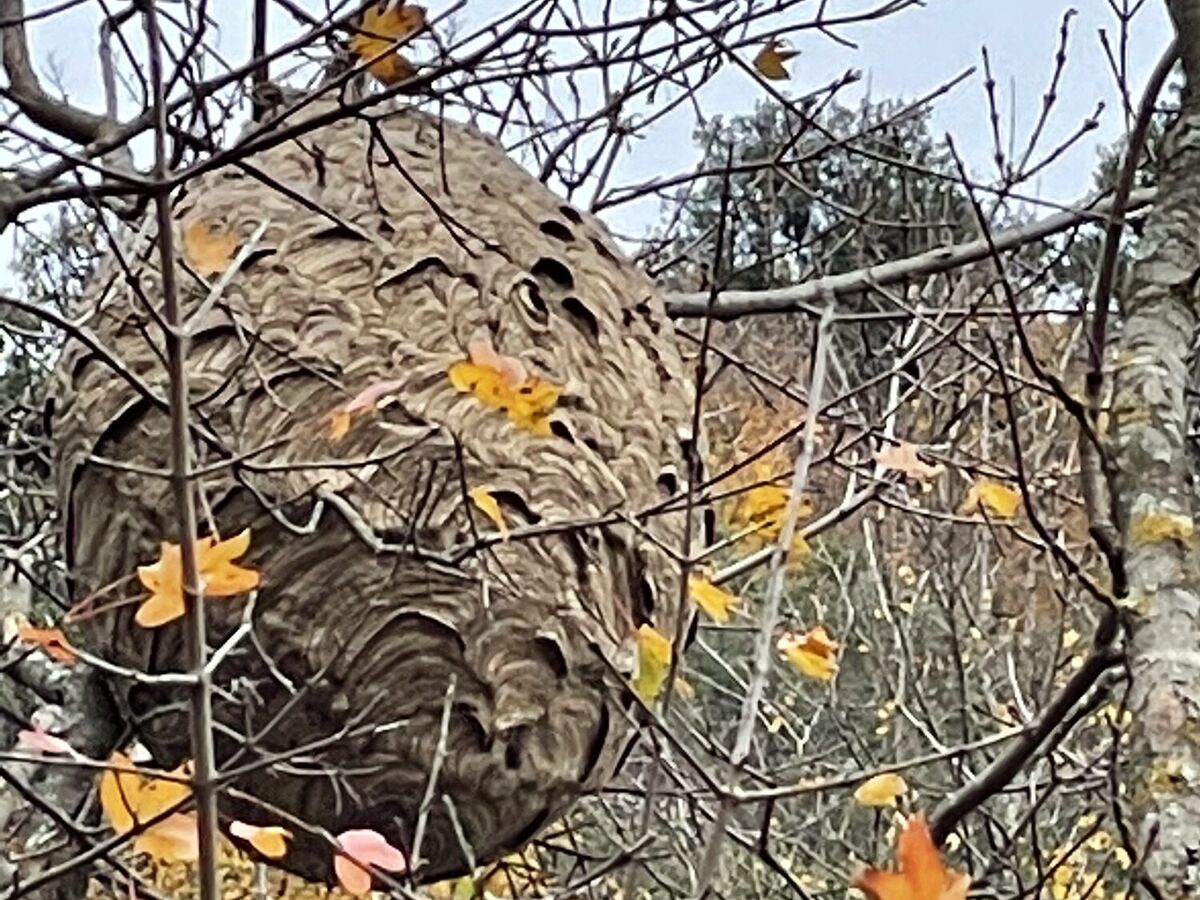
If the location becomes unsuitable or too cramped, the colony moves, usually higher up. The secondary nest is spherical to pear-shaped, with a small opening on the side, and measures around 60 × 80 cm.
According to data from the French National Museum of Natural History, Asian hornet nests are distributed as follows: 73% in trees more than 10 m high, 10% in buildings and 3% in hedges. That is why so many nests are only discovered when the leaves fall.


The European hornet nest
It is always open at the bottom, usually built in a hollow trunk, under a shelter, in a chimney flue, sometimes in the ground or in a wall, but never at the top of trees. Its shape is cylindrical rather than spherical, and it measures around 30 × 60 cm.
Wasp nests
The common wasp nests in the ground or in buildings, in confined spaces: a conical nest of about 30 × 35 cm, with a small, hidden opening at the bottom. The median wasp nests in bushes less than 2 m high: a conical nest of about 20 × 25 cm, with an off-centre opening at the bottom.
In spring, the embryo nest of most wasps looks like a small sphere 5 to 10 cm across with an opening at the bottom — this is what sets it apart from a primary Asian hornet nest.


Can you recognise the Asian hornet now?
For each photo, try to guess which insect it is. Tap a photo to see the answer.
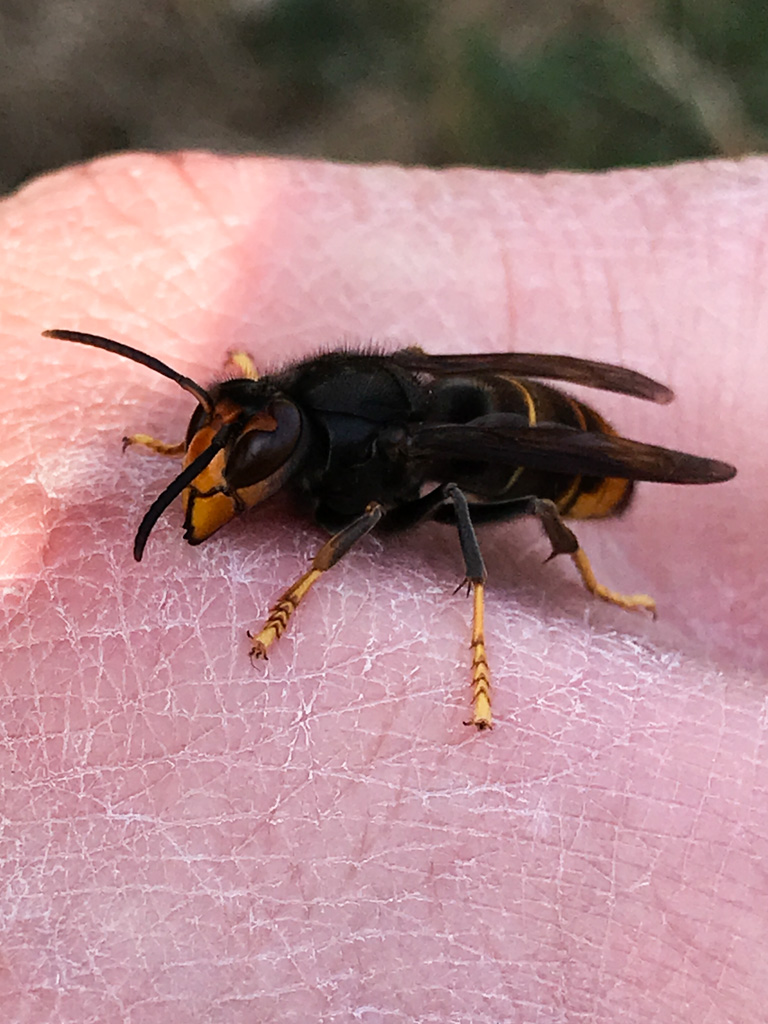 See the answer
Asian hornet
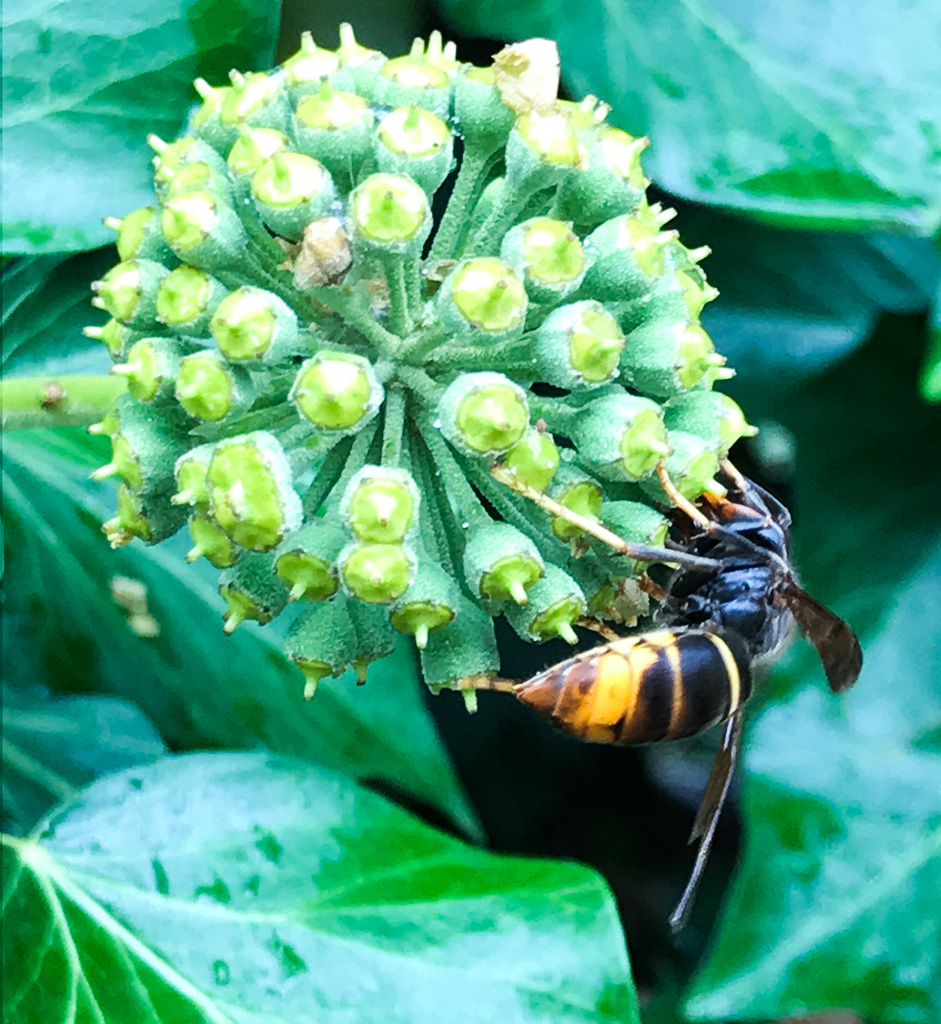 See the answer
Asian hornet
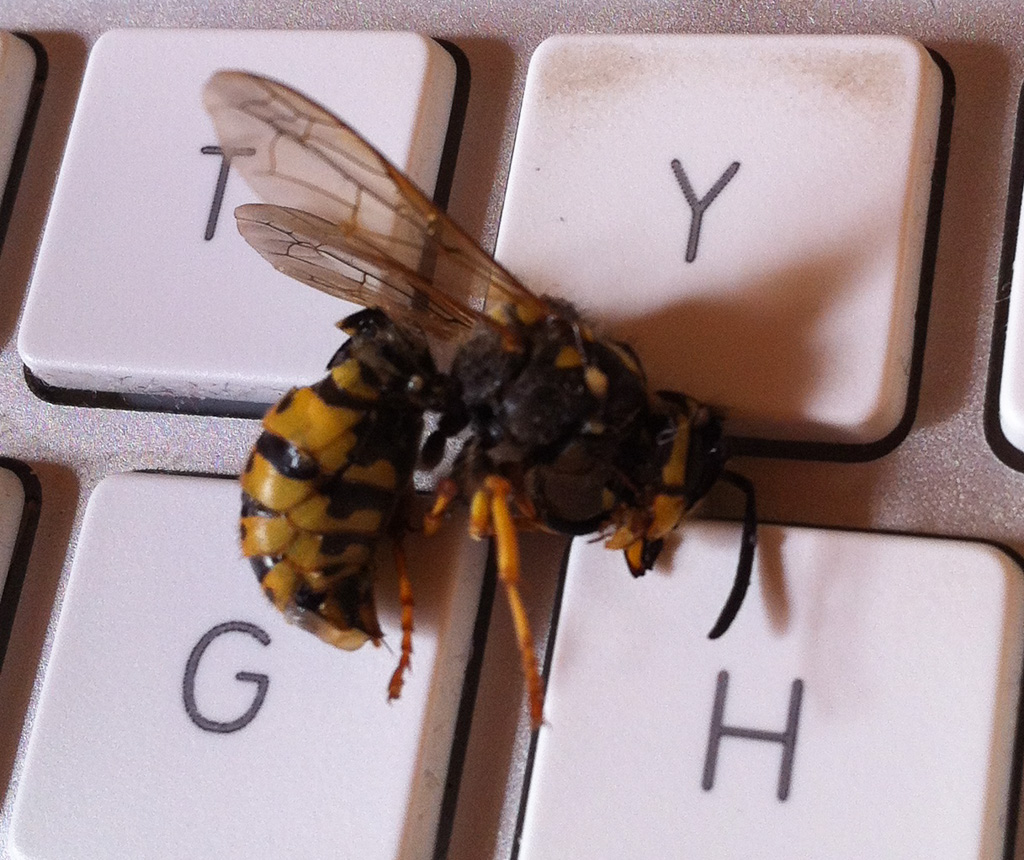 See the answer
European hornet
 See the answer
Asian hornet
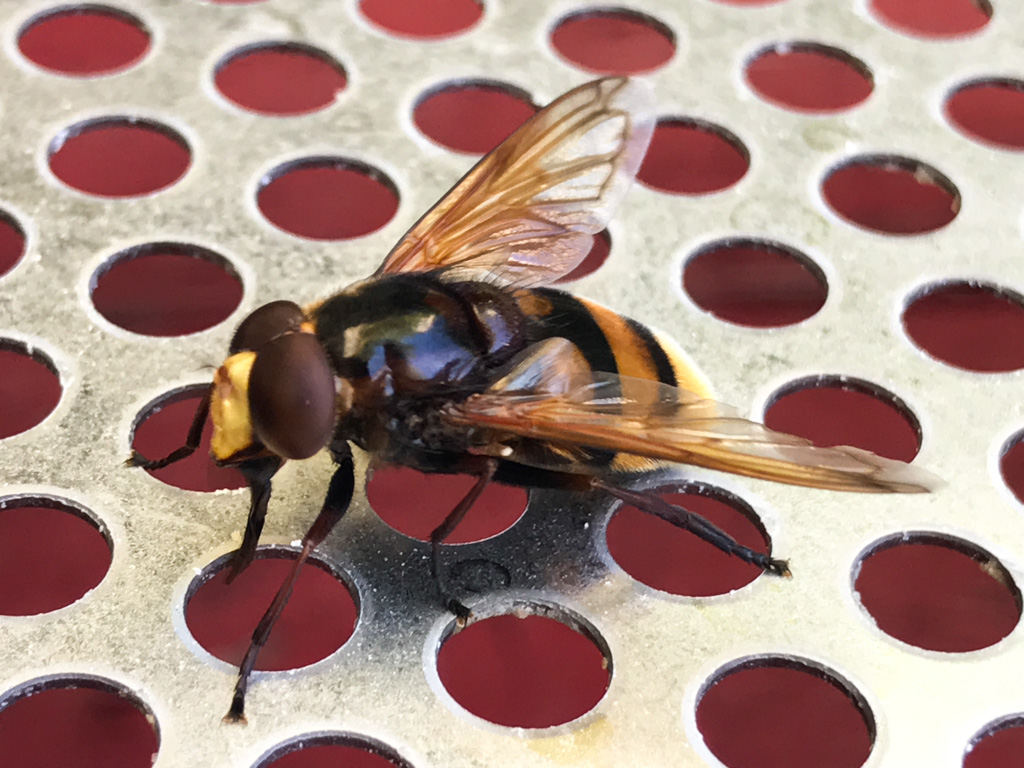 See the answer
Hornet hoverfly — it is a fly, it does not sting
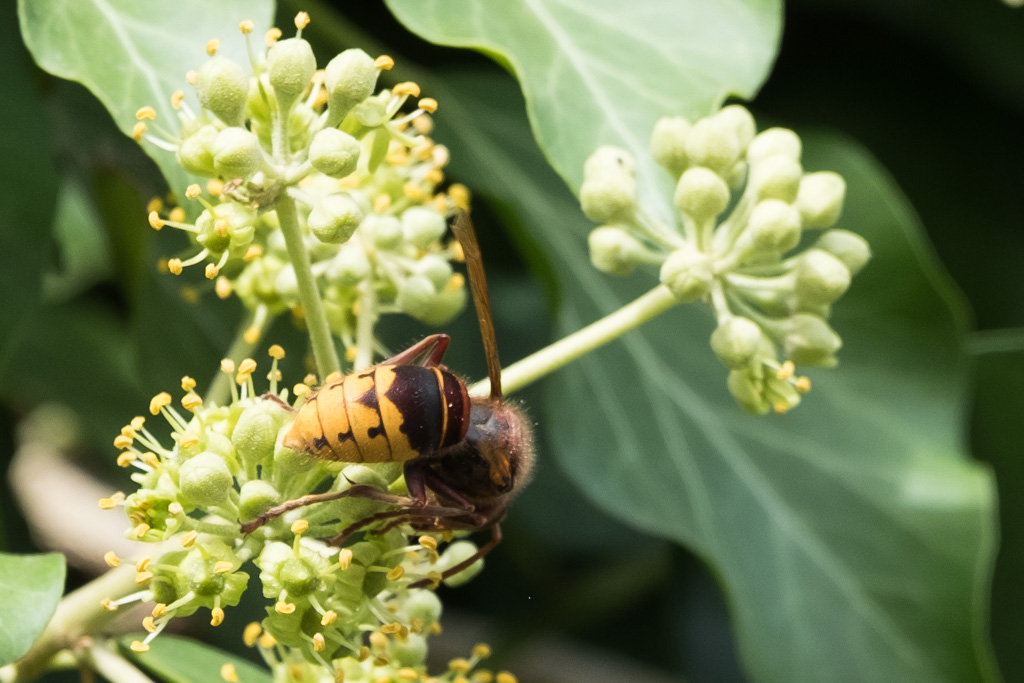 See the answer
European hornet
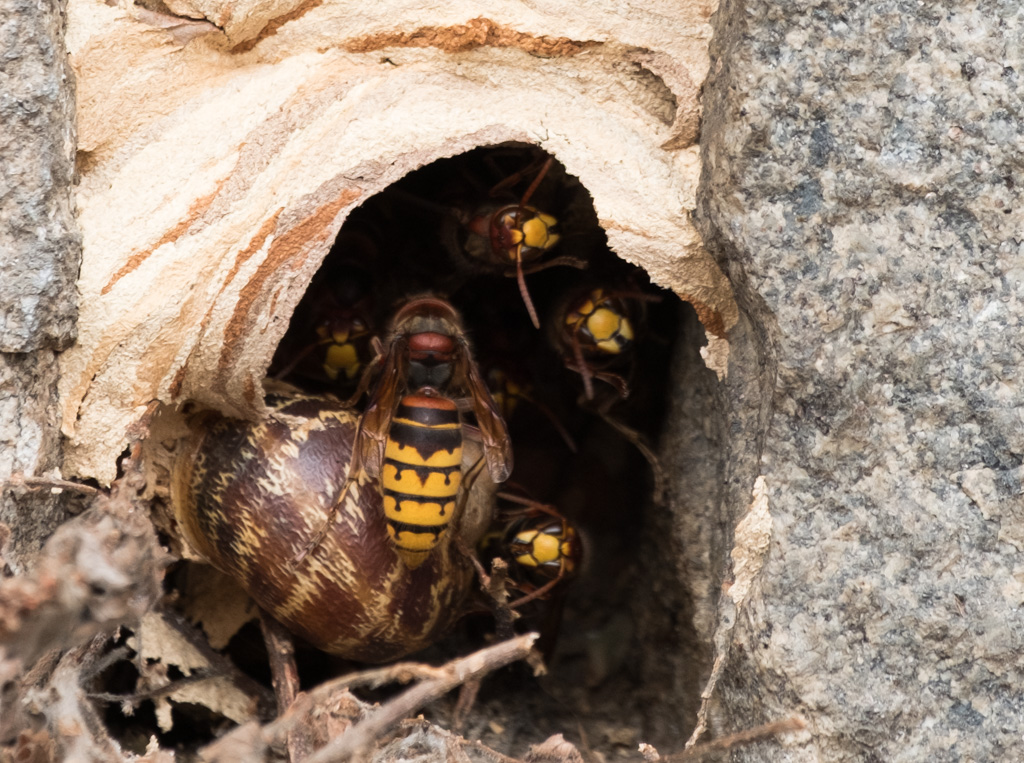 See the answer
European hornet
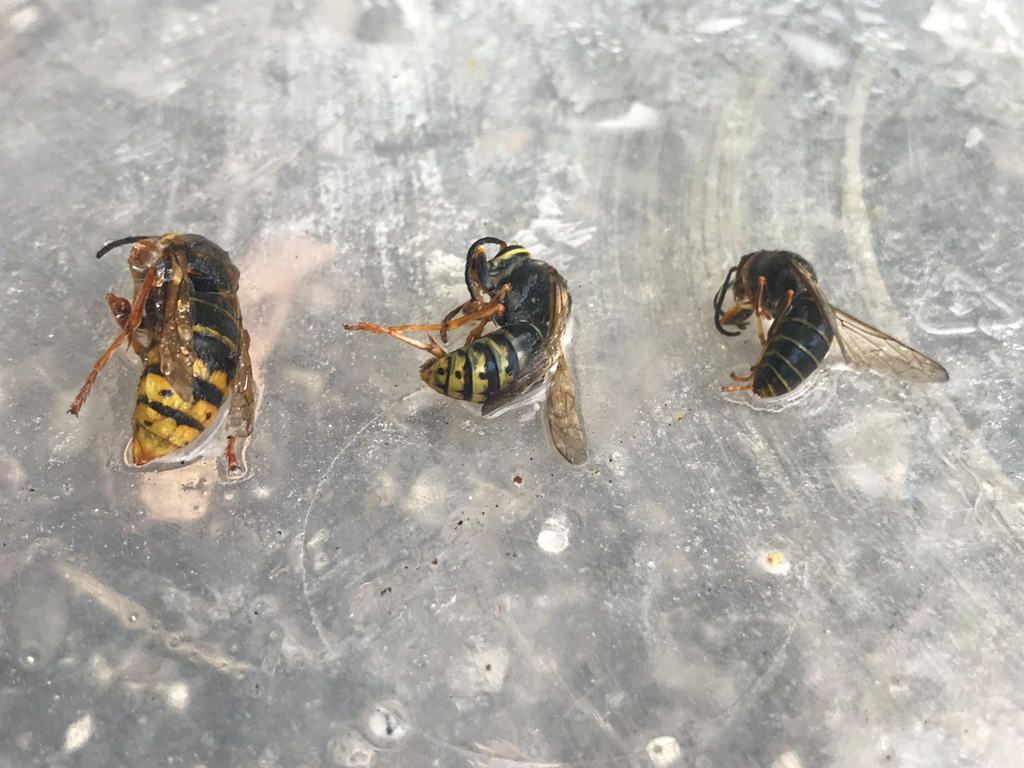 See the answer
Wasps
The identification sheet of the National Museum of Natural History
This identification sheet was produced by the French National Museum of Natural History (in French). Printed on an A4 sheet, the insects appear at real size — the most reliable way to settle a doubt.
Frequently asked questions
Is the Asian hornet bigger than the European hornet?
No, it is the other way round. European hornet queens reach 35 mm, against 32 mm at most for the Asian hornet. The idea of a "giant hornet" comes from confusion with other species, notably the giant woodwasp, which reaches 4.5 cm.
Can you recognise it in flight?
Yes, by its legs. The yellow tips are very visible in flight, and this is the only criterion you can really read without immobilising the insect.
What can you see at what time of year?
In spring, lone foundresses and small primary nests. In summer, workers and the growth of the secondary nest. In late summer and autumn, hornets in front of hives and nests that become visible as the leaves fall.
I saw a really huge hornet, is it a new species?
Almost always not: the European hornet reaches 35 mm and is impressive enough. Asian giant hornets, including the southern giant hornet (Vespa soror), have never been seen in France.
I am not sure: what should I do?
Take a photo from a distance, without going near the nest, and make a report: the identification will be checked by a referent. Where and how to report?
Sources
Information checked on 14/08/2026.