

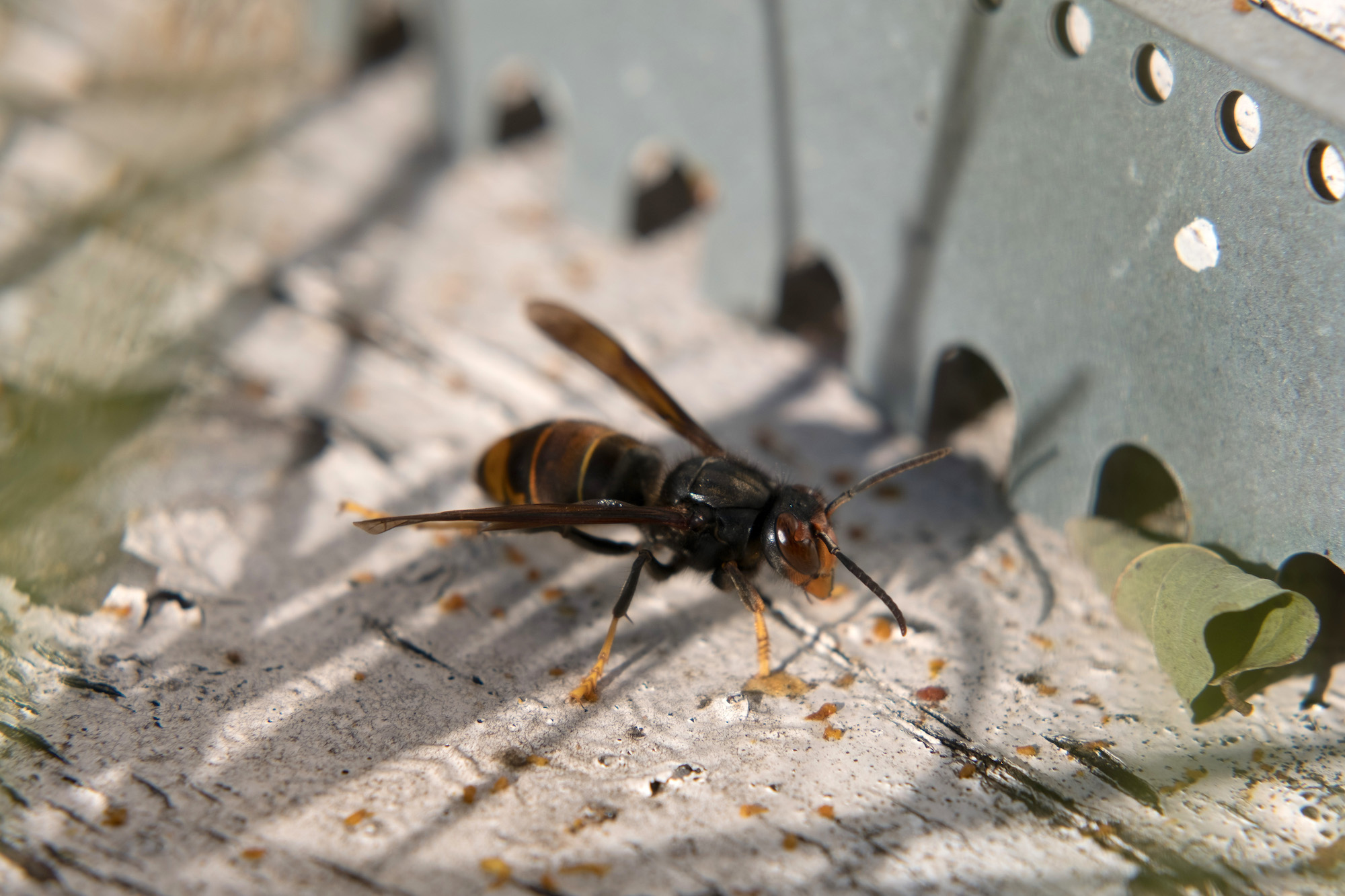
Because a hive is an abundant, concentrated and predictable source of protein. The Asian hornet is an opportunistic predator: it targets the prey that is easiest to catch locally, and from mid-summer nothing fits that description better than an apiary.
Key points
- The hornet hunts foragers while hovering in front of the hive entrance, from summer onwards.
- The main damage is not the number of bees taken, but the blocking of the colony's activity.
- A study by the French National Museum of Natural History estimates that one nest eats more than 11 kg of insects between March and October, about 38% of them honey bees.
- Under heavy pressure, losses can reach 30 to 50% of the colonies of a beekeeping operation.
- The Asian hornet is a generalist predator, not a bee specialist.
An opportunistic predator, not a bee specialist
This is an important nuance, often lost in alarmist articles.
The Asian hornet is interested in any source of animal protein and eats a wide variety of insects. It targets above all prey that is locally abundant and easy to reach. The honey bee is therefore not chosen for its own sake: it becomes the dominant target because a hive concentrates, in one fixed spot, thousands of individuals going in and out all day long.
The Museum study cited in the draft national plan estimates that a nest eats on average more than 11 kilograms of insects between March and October, made up of about 38% honey bees, 30% flies and 20% wasps.
How does predation work?
The behaviour is very distinctive and confirms predation pressure on an apiary beyond doubt.
From summer, adult hornets take up position hovering in front of the hive entrance, a few dozen centimetres from the landing board. There they intercept foragers on their way back, laden and therefore less agile. The prey is carried off and cut up, and only the thorax — the richest in protein — is brought back to the nest to feed the larvae.
A single hovering hornet is enough to change the behaviour of the whole colony.
The real damage: the colony is paralysed
This is what beekeepers notice even before counting the bees lost.
Beyond direct predation, the presence of hornets in front of the hive causes significant stress which:
- severely disrupts foraging — bees stop going out, or go out less;
- limits the build-up of the reserves needed for winter.
It is this mechanism, more than the predation itself, that puts colonies at risk. A colony that could not build up its winter reserves in September will not survive the cold season, even if the hornets are gone by December.
Under heavy pressure, the risk of colony mortality can rise sharply, up to 30 to 50% of the colonies of an operation.
What is the impact nationally?
The orders of magnitude given in the draft national control plan are as follows:
- the Asian hornet is thought to account for about 20% of honey bee mortality, with wide variation depending on local conditions;
- in the most unfavourable modelling scenarios, up to 30% of colonies could be destroyed each year;
- the corresponding replacement cost could reach 26% of honey production income, or nearly €12 million a year nationally, excluding indirect losses.
These estimates come from the draft national plan, a document put to public consultation in spring 2026 and not yet adopted. They are orders of magnitude, not measurements.
What about other crops?
The impact is not limited to the apiary. Adult hornets also feed on ripe fruit, and direct damage is seen in orchards and vineyards — grapes, apples, pears — with lower yields and poorer quality harvests. In vineyards, this damage can encourage rot.
There is also an indirect effect: less pollination as colonies weaken.
Should we talk about a collapse of bees?
No, and this is a point where precision matters.
The Asian hornet is one of the causes of colony mortality, alongside varroa, pathogens, farming practices and weather. Available estimates attribute a significant but minority share of this mortality to it.
The draft national plan also points out that completely eradicating the species is no longer possible given how widely it has spread. Public strategy is now about managing and limiting its effects, not eliminating it.
How to protect an apiary from the Asian hornet?
Sources
Information checked on 14/08/2026.